Nice feedback stopped being enough. You want to be paid properly for the work you’re already doing.
Because, let’s be honest… kudos don’t pay your bills.
You’ve spent years putting in the work, proving yourself, taking on more responsibility and showing your company exactly what you’re capable of.
And every time you think, surely NOW they’ll pay me what I’m worth… the goalposts move again.
You’re already doing the work, taking on more responsibility, proving yourself over and over - so why the hell aren’t you being paid for it? Somewhere along the way, the rules changed, and nobody thought to tell you.
Let me help you decode the modern corporate system and figure out how to get your work, your value and your pay properly aligned.
Explore my services →

The Real Cost of Doing More Work for the Same Pay
You stay late covering understaffed projects, pick up the work nobody else has time for, take on more responsibility and still get told there’s more you could have done better. Then the budget that apparently wasn’t there for your pay rise suddenly appears for AI licences, new hires or another initiative...
...and you can’t help but think: so what exactly am I working this hard for?
Because now you’re doing things you were never technically hired to do. You’re leading meetings, making decisions, fixing problems, bringing people together, handling the work that lands on your desk because “you’re so good at it” and yet when you ask what it takes to move up, suddenly there’s another box you need to tick.
Another skill to prove. Another reason why now isn’t quite the right time.
And after a while, you start questioning yourself.
Am I actually ready? Am I asking for too much? Maybe I need to do a little more first.
Meanwhile, you’re already doing more. That is the problem this work is built to solve.
The Person Who Decoded the Corporate System From the Inside
I’m Natalia Woźniak - former Art Director, ex-Accenture Manager in Consulting & Strategy and ICF-certified coach. I’ve spent six years learning how the corporate system and office politics actually work from the inside out.
I started my career in advertising. At 24, I was leading a global campaign across 64 countries and 37 languages. At 25, I became an Art Director, built a creative studio from scratch and led campaigns for brands including McDonald’s, Starbucks, IKEA and Fiat.
I learnt early that being good at your job is only part of the game. How you communicate, how you frame an idea, who you build relationships with and how you navigate different levels of seniority can completely change how your work is perceived.
Then, at 28, I lost my job. had to start again from the bottom in consulting and strategy, while doing work at a much more senior level than my title suggested.
Claude responded: I started my second career at 28 after losing my job in December 2

I was promoted twice in four years - the second time during a promotion freeze when most promotions weren't happening. My salary tripled.
As a Manager, I led projects across Europe, the Middle East, Asia and Latin America, managed a team of 40, and co-developed the career progression framework for a 70-person eCommerce practice, from Analyst to Principal Director. I’ve also spent years studying how career progression really works: communication, psychology, leadership, power, office politics and the patterns that determine who gets noticed, trusted and promoted.
I’m ICF-certified, with further training in NLP and trauma-informed coaching through the British Coaching Academy. After holding managerial positions across different industries, I know how to lead conversations with everyone from clients to senior executives - how to read the room, how to frame an idea, when to push, when to listen and how to make sure your message actually lands.
I’ve spent years learning how the corporate system works from the inside out.
What I couldn’t find, I built. Because you shouldn’t have to figure this out through trial and error.
That’s exactly what this work is here to help you do.
Meet Natalia - Your Career Bestie
Work With Me 1:1
Unlock your career and purpose to get paid what you deserve and find your why.

Mentoring Mastery - International Leadership Communication
You’re trusted, you’re delivering, and you’re still waiting for the company to finally recognise the level you’re already operating at.
We decode how promotion and salary decisions actually get made, build your visibility with senior leaders, and sharpen the communication that gets your work noticed, trusted and acted on.
-
Decode what your company actually looks for when making promotion decisions
-
Build presence and credibility with senior decision-makers
-
Communicate clearly and confidently across stakeholders, vendors and clients
-
Strengthen your project and programme management so you can deliver with confidence and handle the audits, scrutiny and senior-level conversations that come with it

Coaching Clarity - Career Direction and Workplace Wellbeing
You built the career, earned the experience, created the stability and somehow, the career that was supposed to make life feel better is leaving you more exhausted, disconnected and unsure of what comes next.
We work out whether to stay or change direction, what you take with you if you move, and what’s really driving the exhaustion underneath it all, so you can make decisions about your career and wellbeing from clarity, not depletion.
-
Rebuild a sense of direction and purpose in your career
-
Identify what you already have and where it has value in today’s market
-
Understand what’s affecting your confidence, energy and wellbeing at work
-
Leave with a direction you chose, rather than one you defaulted into because you were too exhausted to choose
Welcome to the
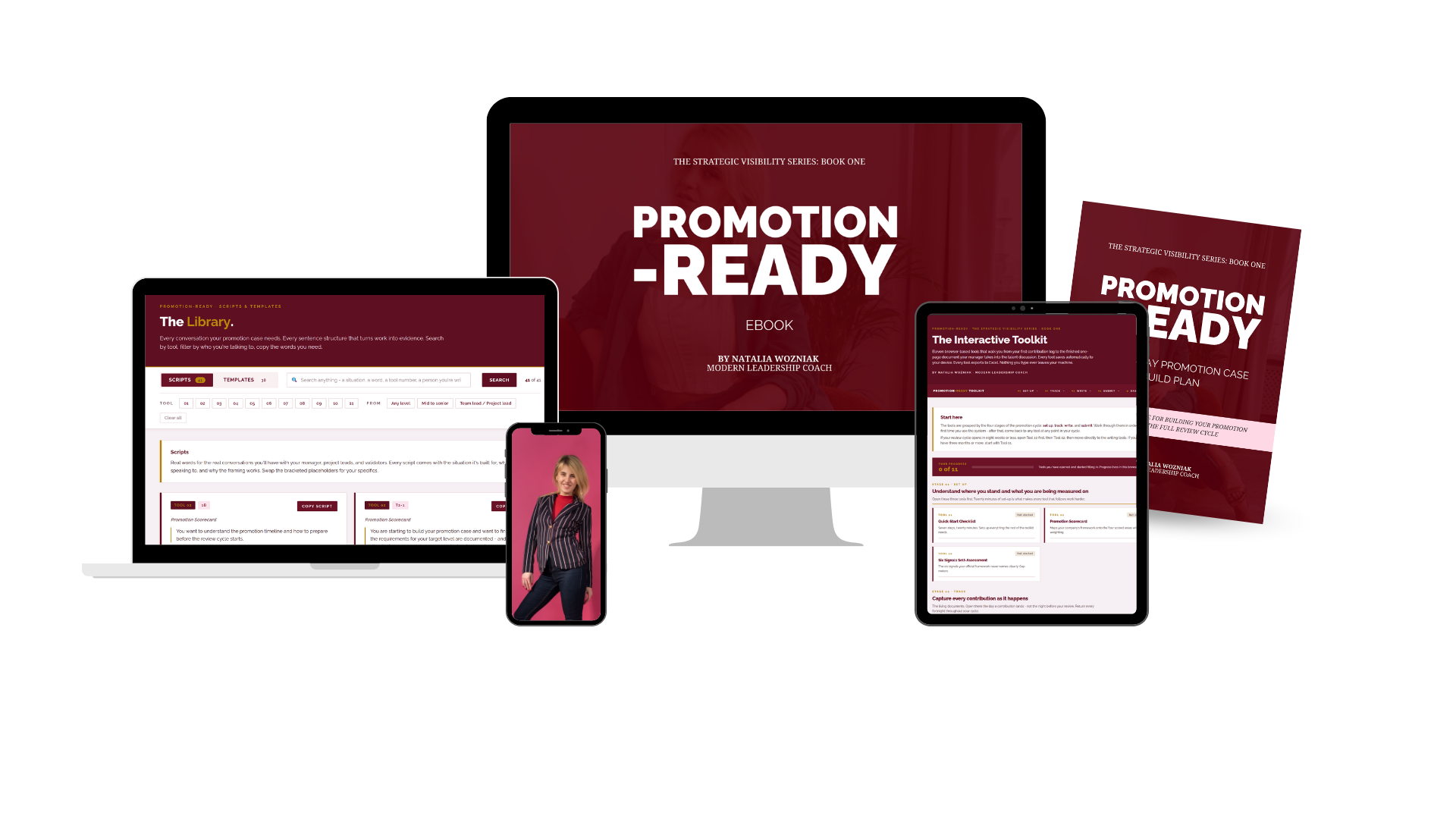
PROMOTION-READY
You’re a high-performer working in corporate who knows you’re already doing work above your level, but somehow, you’re STILL not getting the promotion you deserve.
Promotion-Ready is the 6-month plan for navigating the promotion game your boss will never explain, so you can build visibility around your work, position your achievements like a senior leader, and give decision-makers the evidence they need to promote you.
Join the Waitlist⚡️

One hour with Natalia gave me more than years of overthinking. I walked away with clarity and a concrete strategy.
Monika Hoja
Creative Director – Poland
She brought clarity, structure, and encouragement to every session, helping me make meaningful changes and reconnect with what’s most important in my life.
Jessica Duvillard
IT Project Leader - Switzerland

I feel more confident in my leadership role at the corporate job being able to lead my team with more clarity and talk about suggestions and changes to higher management.
Leny Haller
Product Owner - Sweden
Your Next Move Starts Here
You don’t have to figure out your next move on your own.
Maybe you’ve reached the point where you know something needs to change, but you’re not sure what that change should actually look like. You’re too close to your situation to see the clearest way forward.
